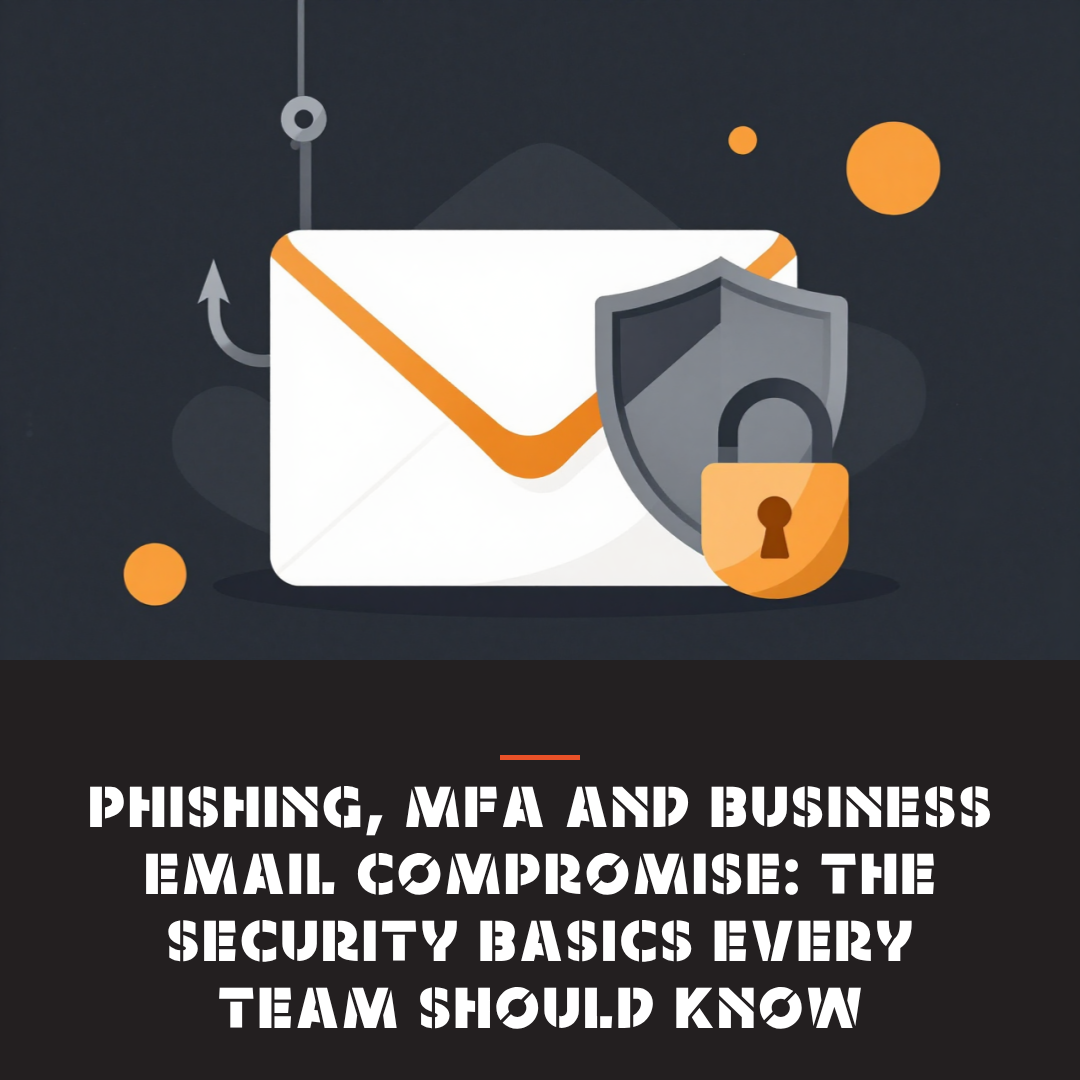
Phishing, MFA and Business Email Compromise: The Security Basics Every Team Should Know
Introduction
When organisations talk about cyber risk, they often imagine malware, hackers or complex technical attacks. In reality, many serious incidents still start with something far more ordinary: an email that looked genuine, a login prompt that seemed familiar or a payment request that arrived at just the wrong moment.
That is why phishing, multi-factor authentication and business email compromise should be on every organisation’s radar. They are not specialist topics. They are part of the everyday security basics that make the difference between a near miss and a serious incident.
The challenge is that these issues sit at the intersection of people, process and technology. Good protection is not only about filters and policies. It is also about how confident people feel when they are under pressure, how clearly responsibilities are defined and how easy it is to do the right thing.
Why phishing still works
Phishing remains effective because it exploits urgency, trust and routine. Attackers do not need to break through a firewall if they can persuade someone to click a link, open a document or approve a sign-in request. Modern phishing emails are often more convincing than people expect, especially when they imitate suppliers, colleagues or familiar brands.
For smaller organisations, the risk is increased when workloads are high and processes are informal. A rushed member of staff may not notice a domain spelling change or may approve a request because they recognise the sender name. Finance teams, senior leaders and anyone handling sensitive information are especially attractive targets, but no one is completely immune.
That is why phishing protection should never be treated as an IT-only issue. It is an organisational discipline that relies on technical controls, user awareness and simple escalation paths when something feels off.
What business email compromise looks like
Business email compromise is often less dramatic than people imagine. It may involve a compromised mailbox, a spoofed sender or a believable request to change bank details or approve an urgent payment. Because the message appears to come from a trusted source, people naturally lower their guard.
The damage can be significant even without ransomware or a large-scale breach. A single fraudulent payment, leaked conversation or compromised mailbox can create financial loss, confusion and reputational harm very quickly. In charities and non-profits, the consequences can also affect beneficiaries, donors and trustees who expect strong stewardship of information and funds.
A key point here is that technical tools help, but they cannot replace sound process. High-risk actions such as payment changes or sensitive approvals should always involve verification through a second channel. If a process depends entirely on email trust, it is already vulnerable.
Why MFA matters and where organisations get it wrong
Multi-factor authentication is one of the simplest and most effective ways to reduce account compromise. If a password is guessed, reused or stolen, the additional factor creates an extra barrier that can stop an attacker from getting in. For that reason alone, MFA should be standard across modern organisations.
However, not all MFA implementations are equally strong. Some organisations enable it only for administrators or a subset of users. Others introduce it but leave legacy sign-in methods available, weakening the benefit. There are also user experience issues. If sign-in prompts appear too often or without context, people can develop “approval fatigue” and accept requests automatically.
Good MFA should therefore be applied consistently and configured sensibly. It should improve security without becoming so intrusive that it trains people to ignore it.
How to build safer habits without creating friction
User awareness training is often necessary, but it works best when it is practical and relevant. People do not need generic warnings once a year. They need short, memorable guidance linked to what they actually do: checking requests, spotting unusual links, verifying bank detail changes and knowing what to do when something feels suspicious.
Just as importantly, people need permission to pause. In many workplaces, speed is rewarded so strongly that caution can feel like an inconvenience. Good cyber culture changes that. It makes verification normal, not awkward. It encourages people to ask before acting, especially when urgency is part of the message.
Leaders play a role here as well. If senior staff model careful behaviour and support staff when they raise concerns, the whole organisation becomes safer.
Quick wins to put in place now
Start by ensuring MFA is enabled for everyone, not just a select few. Review high-risk roles such as finance, senior leadership and administrators first, then confirm the wider estate is covered. Remove old accounts, review forwarding rules and check whether mailbox auditing and alerting are configured properly.
Next, review your approval processes. Any request involving payments, bank changes, sensitive data or unusual access should have an out-of-band verification step. Finally, give staff a simple reporting route. If someone spots a suspicious email, they should know exactly what to do and where to send it.
These are not complicated changes, but together they reduce risk significantly.
Final thoughts
Phishing and business email compromise are not just technical problems. They are everyday organisational risks, and they are most dangerous when people assume someone else is covering them. The strongest response is a combination of smarter controls, safer processes and a culture where verification is encouraged rather than viewed as a nuisance.
If your organisation can make it easy for people to work safely, you are already in a much stronger position. Security basics may not sound glamorous, but they remain some of the most valuable protections any small organisation can put in place.
And when those basics are in place, teams can work with more confidence instead of constantly second-guessing whether the next email is a problem waiting to happen.
If your team needs help tightening email security, improving MFA and building safer everyday habits, TeamTech4 can help you put a practical plan in place without making life harder for users.