IT Strategy for Growing UK SMEs and Non-Profits: What Good Looks Like
Introduction
When people hear the phrase “IT strategy”, they often picture a large, formal document built for enterprise boards and long planning cycles. For smaller organisations, that can make the whole idea feel distant or unnecessary. But growth without strategy usually leads to something else: reactive decisions, duplicated tools, unclear priorities and avoidable risk.
A good IT strategy for an SME, charity or non-profit does not need to be overcomplicated. It should simply answer a practical question: how will technology support the organisation’s goals over the next one to three years in a way that is realistic, secure and manageable?
That means connecting people, systems, data, resilience and budget instead of treating IT as a string of separate purchases. In this article, we will look at what “good” really looks like for smaller organisations.
IT strategy is not just a shopping list
One of the most common traps is confusing strategy with procurement. New laptops, a better broadband contract, a cloud migration or a cyber project may all be part of the answer, but on their own they do not amount to a strategy.
A strategy starts with organisational priorities. Are you growing headcount? Opening new locations? Improving service delivery? Trying to modernise ways of working? Managing risk more carefully? Supporting hybrid teams? The technology decisions should flow from those aims, not sit alongside them as a separate conversation.
This is particularly important for non-profits and charities, where resources are limited and every investment needs to justify itself in terms of impact as well as efficiency.
The key areas every smaller organisation should consider
A practical IT strategy usually covers five core areas. First, people: how staff work, what support they need and how technology can make their day-to-day experience easier rather than more fragmented. Second, systems: the platforms and applications the organisation relies on, how well they integrate and whether there is duplication or technical debt.
Third, security and governance: access control, device management, backups, data handling and the overall maturity of the environment. Fourth, resilience and continuity: what happens if something goes wrong, from a cyber incident to an outage or a key supplier issue. Fifth, connectivity and infrastructure: the network, broadband, devices and support arrangements that underpin everything else.
If any one of these is ignored, the strategy will feel unbalanced very quickly.
How to prioritise when budget is limited
Smaller organisations rarely have the luxury of doing everything at once, so prioritisation matters. The best place to begin is usually where risk and friction overlap. Which problems are causing the most operational drag? Which weaknesses would have the biggest impact if left unresolved? Where is the organisation paying for complexity it no longer needs?
This approach helps avoid two common mistakes: over-investing in low-impact improvements and postponing important fixes because they are not exciting enough to champion. Strategic planning should not be driven by novelty. It should be driven by value, risk and timing.
Often, that means improving fundamentals first: simplifying systems, strengthening security, reviewing support arrangements and creating a clearer roadmap for the next phase of change.
What leaders should review regularly
An IT strategy should not disappear into a folder after it is written. Leadership teams should revisit a small set of measures and questions regularly. Are the core systems still fit for purpose? Are support issues increasing? Are staff working in safer, more consistent ways? Have new risks emerged around cyber security, data protection or supplier dependency? Is the organisation becoming more resilient or simply more reliant on aging workarounds?
These reviews do not need to be highly technical. In fact, they are better when they are understood by operational leaders as well as IT teams. Good IT strategy is a shared organisational conversation, not just a technical one.
Where external consultancy can add value
Many smaller organisations do not need a full-time strategic IT role, but they do benefit from periodic external input. An outside perspective can help identify blind spots, challenge assumptions and translate complex decisions into a clearer roadmap. That is especially useful when the organisation is growing, restructuring or rethinking how technology supports service delivery.
The best consultancy support should feel grounded and practical. It should help leaders make better decisions, not overwhelm them with theory or unnecessary jargon. For smaller organisations, the value often comes from clarity: understanding what needs attention now, what can wait and how different decisions connect.
Final thoughts
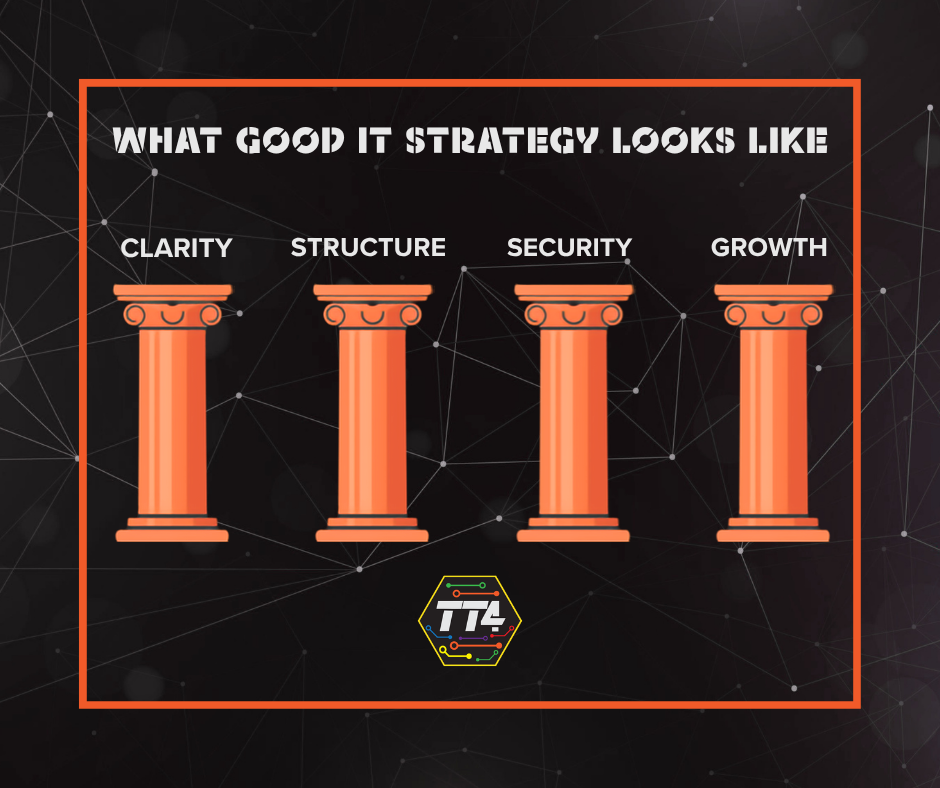
Good IT strategy for a growing organisation is not about creating the biggest plan. It is about creating the clearest one. When technology decisions are linked to people, risk, resilience and operational goals, the organisation becomes more deliberate and less reactive.
That does not mean everything will be predictable. But it does mean the next decision is more likely to fit into a wider direction rather than becoming another isolated fix.
For SMEs, charities and non-profits, that kind of clarity can make the difference between technology being a drag on progress and technology becoming a genuine enabler of it.
If your organisation needs a clearer IT roadmap that balances growth, risk and day-to-day reality, TeamTech4 can help you define a practical strategy rather than a long list of disconnected ideas, get in touch today.